










Kaitlyn - Just Getting Started
 Kaitlyn was eleven years old when she stumbled upon a book I was reading. She brought it to me and, as if she had just discovered a brand new planet, she exclaimed with a sparkle in her voice, “Mom, these kids are like me!” My heart skipped a beat— she was obviously ready to learn that the children in the book, like her, were born with Down syndrome.
I am very pleased that she has the cognitive ability to recognize that she is different from other people, just as she recognizes, and perhaps has a better perspective than most people, that we are all different, special, and unique. How incredible it is that she knows what chromosomes are; that she has an extra twenty-first chromosome, which makes her similar to other people who have that same extra chromosome; and that it really isn’t all that different from the chromosomes that make some people red-haired like her sister, Jenni, or some people really big, like Shaquille O’Neal. How wonderful it is that she has the capability to process what Down syndrome means, and that she can rise above the usual expectations, despite the fact that she didn’t start off being a “high-functioning” child with Down syndrome. Kaitlyn certainly had a very slow start and didn’t really begin to change her course until she was almost ten and started on an NACD program. Today Kaitlyn definitely has already achieved far more than what traditionally is expected of people with Down syndrome, and she is just really getting started.
Arianna
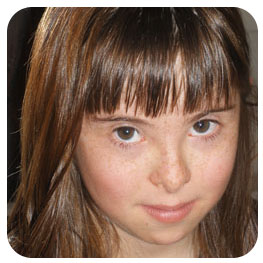 Arianna is 13 years old. She happened to have been born with one extra chromosome, a fact that is neither positive nor negative but certainly has been a challenge for her in many ways. As parents we learned that the medical term is designated Trisomy 21. We feel very strong about using that term. Verbalizing that our daughter had Down Syndrome made us feel that we were making a prophecy about her future that impeded her growing into the person she really was truly capable of becoming. Since day one Arianna has been given an empty book to write her own story (her own life). No prognosis, no predictions were made on her future. She has proved us right. Her potential keeps increasing.

Rebecca Franzen: There's Nothing Like a Home-Based Business
 Becca is 22 years old and is looking for competitive employment. As most people are aware, the current job market in the United States isn’t that great, especially if you have Down syndrome or some other label. For the past three years Becca has been working with our state’s Vocational Rehabilitation office in conjunction with a couple of different local agencies to try to secure employment. We’ve spent a lot of time and effort on this. You might wonder, “What has happened as a result of all of those extra meetings, the time spent in job-site assessments, practicing how to answer interview questions, sitting in a library watching the consultant type for her, not much time spent actually applying for anything, and four different career consultants over the past three years?” Well, it’s pretty disappointing: several job applications submitted, one phone interview, one call to set up an interview which got cancelled when they found out she had a disability and a two-month stint at Papa John’s in a “carved-out” position. Hmmm…kind of makes you wonder if it’s really worth all of that time.
Sonya
by Sue McFerren, as told to Iliana Clift
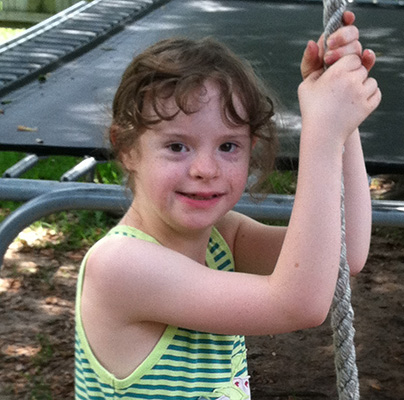 I knew the risks of having a child in my 40s, and I intended to love and care for every child God blessed us with, no matter what. Still, when Sonya was born with Down syndrome I was stunned. Recognizing that having a special needs child in our family would dramatically change all our lives, I took her home and loved her just as much as my other ten children. In a few short weeks we all became crazy about her! Even my sons became more nurturing. Our family doctor, our family, and friends were very kind and encouraging. For months later, so many people immediately wanted to give me advice, share their sympathies, or sell me a product, that I let the older children screen emails and take phone calls. The quiet time bonding with Sonya and pleading with the Lord to help me figure out how to parent a child with special needs was precious and comforting.
Elana's World Show Experience
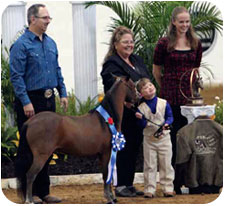 As told by her mom, Lydia
Read about Elana's experience with horses in this article from Miniature Horse World Magazine, December 2010.
Click here to read more (PDF Article)
Reproduced with permission from Miniature Horse World Magazine
Becoming Independent and the Issue of Safety
 Many parents are baffled by how to allow their teen or young adult son or daughter to have more independence and normalcy when they may have little or no sense of danger or caution in public situations. Parents pale at the thought of leaving their teens alone or allowing their young adult son or daughter to go out in the community unescorted.
As we have stated elsewhere in the articles on this website, the individual's processing level has much to do with his or her ability to comprehend complex situations. In addition to that, we really must explore WHY many individuals with DS do not have the necessary skills to function at home alone or in public places without supervision. Is this something that is part of the syndrome? Absolutely not.
Basic Behavioral Principles
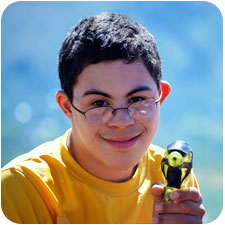 Raising a teen isn’t easy under the best of circumstances. Teens with DS have some additional issues. If your teen has delayed auditory sequential processing, you may have very childish behavior coupled with very adolescent desires for autonomy. To make matters more complex, your teen may also lack a lot of “world experience” making it harder to interact in a mature manner.
How you handle teen behavior will be partially dependent on the processing level of the teen or young adult. If the individual is processing at a three, meaning able to take in three random pieces of information and give it back to you accurately, that individual will be bullish to have his or her own way. This is not an individual really able to problem solve or take other’s feelings into account. For this situation, it is good to have basic rules of conduct. There can be areas of conduct which are non-negotiable. These may be basic hygiene requirements, bedtime, attendance and obeying the rules at school, church or work. At a three level of processing, the individual will try hard to make their own choices in all areas that are perceived as negotiable whether they are practical or reasonable. It is best to keep a positive environment pointing out the good things in all situations.
Bryan Perkins
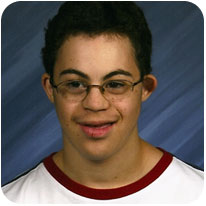 Bryan went to public school through the 4th grade, but we have been homeschooling him since then. He is now 15. He had a really hard time with all the sensory stimulation there, but it took a long time to figure out what the problem was. He has been on NACD program for 2 1/2 years (since age 12) and has made remarkable progress.